
Drug Charges in Georgia: What You Need to Know Before It's Too Late
Facing a drug charge in Georgia puts everything at risk the moment handcuffs go on.
A conviction reaches far beyond a jail cell. Freedom, career, housing, and family stability all stand at risk depending on how the next few weeks go. Professional licenses, financial aid, and custody arrangements all face pressure once prosecutors formally file charges.
Georgia law does provide real defense options, but those options narrow fast without early action. Attorney Richard A. Wilkes has spent more than two decades representing people across Lowndes County and South Georgia who faced exactly what you face right now.
Every decision you make after a drug arrest shapes what comes next. Penalties under Georgia law, constitutional rights during a search, defense strategies that actually hold up, and the mistakes that ruin cases before trial all receive clear answers ahead.
Call 229-375-0291 today to speak directly with Richard A. Wilkes at no charge.
Drug Charges in Georgia From Simple Possession to Trafficking
Georgia prosecutes drug offenses under OCGA 16-13-30, a statute covering four primary categories: simple possession, possession with intent to distribute, trafficking, and manufacturing or distribution. Where a charge lands depends on the substance involved, the quantity found, and how prosecutors read the surrounding evidence. Each category carries different penalties and requires its own defense approach.
Simple Possession Explained
Simple possession is a charge under OCGA 16-13-30(a) that applies when someone holds a controlled substance for personal use. Actual possession means drugs are physically on a person. Constructive possession applies when someone controls a substance without physical contact, such as drugs found in a shared vehicle, a nearby bag, or a residence they occupy.
Possession With Intent to Distribute
Possession with intent to distribute is the charge prosecutors pursue when evidence points toward distribution rather than personal use. Quantity plays a role, but context carries equal weight. Individually packaged baggies, large cash amounts, digital scales, and text messages about transactions all support an intent argument. A conviction carries greater sentencing exposure than simple possession and can escalate if weight crosses statutory thresholds.
Drug Trafficking Under OCGA 16-13-31
Drug trafficking is a charge based on weight under OCGA 16-13-31, with mandatory minimum sentences that apply regardless of prior criminal history. Georgia prosecutors do not need to prove a sale occurred. Crossing a gram threshold alone converts a possession charge into trafficking. Full mandatory minimums and weight thresholds by substance appear in the penalties breakdown further below.
Manufacturing, Sale, and Distribution
Manufacturing of controlled substances is a felony charge in Georgia that applies when someone produces, delivers, or finances drug production. State charges frequently run alongside federal prosecution under 21 USC 841 when distribution crosses state lines or connects to larger networks, compounding sentencing exposure on both tracks.
Prescription Drug Charges
Prescription drug charges in Georgia arise when someone holds a controlled medication without a valid, current prescription. Adderall carries Schedule II status, placing it in the same legal category as cocaine and methamphetamine. Xanax falls under Schedule IV, and both OxyContin and Percocet follow Schedule II classification. Holding any of these without documentation creates felony exposure that many people never anticipate. For drug defense representation in Valdosta, contact an attorney before any formal charges are filed.
Penalties by Drug Type, Weight, and Prior Offenses in Georgia
Georgia calculates drug penalties using four factors simultaneously: the controlled substance involved, its schedule classification, the quantity recovered, and the defendant's prior conviction history. A first offense and a second offense for the same drug and weight carry vastly different sentencing outcomes. Enhancements from drug free school zones or weapon possession can extend sentences beyond the base statutory range.
Penalties for Simple Possession
Schedule I and II possession carries 2 to 15 years for a first offense under Georgia law, with sentencing increasing sharply when prior felony convictions exist. Schedule III, IV, and V possession typically produces 1 to 5 years. Marijuana possession under one ounce remains a misdemeanor, carrying up to 12 months in jail and a $1,000 fine. Any quantity above one ounce moves into felony territory regardless of intent.
Penalties for Possession With Intent to Distribute
Possession with intent to distribute most controlled substances carries 5 to 30 years in Georgia, with the upper range reserved for large quantities or defendants with prior distribution convictions. Marijuana intent to distribute convictions produce 1 to 10 years depending on weight and circumstances. Prosecutors frequently pursue PWID charges when simple possession charges would carry lighter penalties, using packaging, quantity, and communication records to push for the elevated charge.
Penalties for Drug Trafficking in Georgia
Drug trafficking carries mandatory minimum sentences that judges cannot reduce regardless of mitigating circumstances or first offender status. Weight alone determines which minimum applies. An aggressive criminal defense strategy focuses on challenging how weight was measured, how evidence was collected, and whether constructive possession arguments hold up under scrutiny.
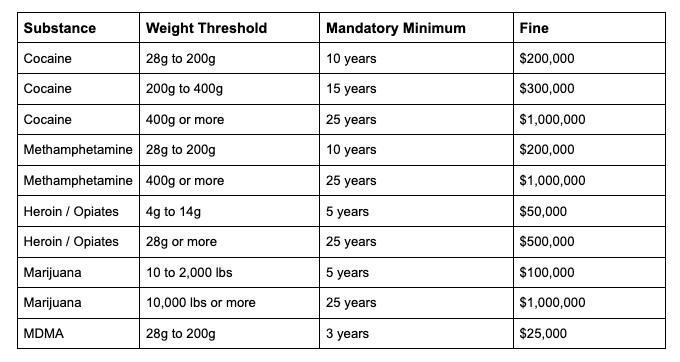
Georgia courts apply these minimums without discretion once weight is established. Challenging how law enforcement measured, stored, and tested the substance becomes one of the few available defense angles once a trafficking charge is filed.
Why the First 72 Hours After a Georgia Drug Arrest Matter Most
Most drug cases are shaped before an attorney ever walks into a courtroom. Evidence gets preserved or lost, statements get recorded, and procedural windows open or close within the first 72 hours of an arrest. Acting correctly during that window protects every option that follows. Acting carelessly can eliminate defenses that would otherwise have held up.
What to Do During the Arrest
Stay calm and keep movements slow and visible to officers.
Provide your name when asked. Georgia law requires identification, but nothing beyond that.
Decline any request to search your person, vehicle, or belongings. Say clearly: "I do not consent to a search." Refusal alone does not create probable cause.
Say nothing further. Anything stated during the arrest becomes part of the record and can surface at trial.
What to Do After Booking
Call a criminal defense attorney before calling family or friends. An attorney can intervene at the bond hearing, which happens fast.
Write down every detail about the arrest while memory holds it: officer names, what was said, where you were stopped, what was searched, and in what order events occurred.
Avoid all discussion of the case on jail phones. Every call from a Georgia county jail is recorded and available to prosecutors.
Decline to answer questions from investigators or detectives without counsel present, regardless of how casual the conversation seems.
Getting Through the Bond Hearing
Georgia requires a first appearance hearing within 48 hours of arrest. At that hearing, a judge sets bond conditions and formally advises you of the charges. Three bond types apply in most Georgia drug cases:
Signature Bond: Released on a written promise to appear. No cash payment required. Typically reserved for lower severity charges.
Cash Bond: A set dollar amount paid before release. A bondsman can post the full amount for a non-refundable percentage fee.
Property Bond: Real property used as collateral in place of cash. Less common but available in some Lowndes County cases.
Mistakes That Can Ruin Your Drug Case Before Trial Starts
Prosecutors rarely win drug cases on evidence alone. Most cases weaken before trial because of decisions made by the defendant in the days and weeks after arrest. Understanding what evidence can be used in a criminal case starts with understanding what you should never hand over voluntarily.
Talking to Police Without a Lawyer: Officers gather admissions through casual conversation, and every statement made without counsel present can surface as evidence at trial.
Consenting to a Search: Verbal or written consent to a search waives Fourth Amendment protections that a defense attorney could otherwise use to suppress key evidence before trial.
Posting About the Case on Social Media: Prosecutors review social media accounts routinely, and a single comment, photo, or location tag can become damaging courtroom evidence against you.
Missing a Court Date or Deadline: Failure to appear generates a bench warrant immediately, signals unreliability to the court, and eliminates negotiating leverage your attorney would otherwise hold.
Contacting Co-Defendants or Witnesses: Reaching out to anyone else named in the case opens exposure to witness tampering charges and provides prosecutors with additional leverage at sentencing.
Waiting Too Long to Hire an Attorney: Every week without legal counsel narrows the available defenses, as evidence gets processed, witnesses' memories change, and pretrial motions become harder to file.
Lying to Your Own Lawyer: Defense strategy builds entirely on accurate facts. Withholding information from your attorney creates courtroom surprises that damage outcomes and limit options mid-trial.
Accepting a Plea Without Exploring Alternatives: Prosecutors extend plea offers because cases carry weaknesses. Signing without negotiation surrenders leverage an experienced attorney would have pressed hard on your behalf.
Know Your Rights During a Drug Arrest or Search in Georgia
Constitutional protections apply from the moment a law enforcement officer approaches you, not from the moment of formal arrest. Knowing exactly what those protections cover and where they stop gives your attorney real tools to work with when building a defense.
Fourth Amendment Protections in Georgia
Probable cause means an officer must have specific, articulable facts suggesting criminal activity before conducting a search. A hunch, a neighborhood's reputation, or nervousness alone does not meet that standard. Officers who conduct a search without a warrant or a valid exception create grounds for suppression, which removes that evidence from trial entirely.
Warrant requirements protect homes, vehicles, and personal property. Georgia courts apply the Fourth Amendment alongside state constitutional provisions, sometimes offering broader protection than the federal floor.
Searches Without Consent
Four exceptions allow warrantless searches under Georgia law:
Plain View Doctrine: Officers may seize contraband visible in plain sight without a warrant if they are lawfully present at the location.
Automobile Exception: Probable cause to believe a vehicle contains contraband permits a warrantless search of that vehicle under both federal and Georgia precedent.
Search Incident to Arrest: A lawful arrest allows officers to search the immediate area around a person for weapons and evidence.
Exigent Circumstances: Imminent destruction of evidence or an immediate safety threat can justify bypassing the warrant requirement.
Phone and Vehicle Searches
Phone searches require a warrant under Riley v California, a United States Supreme Court ruling that Georgia courts follow. Officers cannot search a phone's contents simply because they have arrested its owner. Consent changes that calculation entirely, which is why declining to unlock or hand over a phone protects everything stored on it.
Vehicle searches follow a different standard. Giving an officer permission to search a car extends that consent further than most people intend. A consent search of a vehicle can include locked compartments, the trunk, and any containers inside, unless you limit the scope verbally and clearly at the time of the search.
Suppression is the exclusionary rule in action. Evidence obtained through an unlawful search cannot be used at trial, and when that evidence formed the foundation of the prosecution's case, suppression often ends the matter before a jury ever convenes.
First Offender, Conditional Discharge, or Drug Court Options
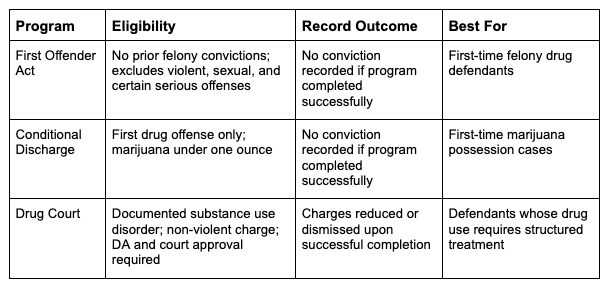
Georgia provides three distinct diversion paths for qualifying drug defendants, and each one produces a different outcome for criminal records, sentencing exposure, and long-term consequences. Choosing the right path requires understanding eligibility requirements, program demands, and what happens if completion fails.
Georgia First Offender Act Explained
Georgia's First Offender Act allows a qualifying defendant to complete probation, pay fines, and fulfill program conditions without a felony conviction attaching to their record. Successful completion seals the case from public view. Employers, landlords, and licensing boards cannot access a First Offender disposition the same way a standard conviction appears on a background check. Eligibility requires no prior felony history and excludes charges involving violence, sexual offenses, and certain drug trafficking thresholds.
Conditional Discharge for Marijuana Cases
Conditional Discharge under OCGA 16-13-2 applies exclusively to first-time possession of marijuana under one ounce. A judge places the defendant on probation without entering a conviction. Completing probation, passing drug screenings, and paying required fees results in dismissal of the charge. Only one Conditional Discharge is available in a lifetime, and it does not extend to any other controlled substance or a second marijuana offense.
Drug Court Programs in Georgia
Drug Court operates as an intensive supervision program combining regular court appearances, mandatory treatment, frequent drug testing, and accountability hearings. Lowndes County Drug Court targets defendants whose charges connect directly to substance use disorder. Successful completion leads to charge reduction or dismissal. Participants who fail testing, miss appointments, or violate program conditions return to standard prosecution with full sentencing exposure reinstated.
Failing any of these three programs carries serious consequences. Revocation returns the original charge with full sentencing exposure, and judges often impose sentences harsher than what a negotiated plea would have produced at the outset.
How to Vet a Georgia Drug Defense Lawyer Before You Hire One
Not every criminal defense attorney brings the right background to a drug case. Asking direct questions before signing a retainer agreement reveals whether an attorney can actually handle the specific charge, the local court, and the prosecution strategy involved.
Trial Experience in Drug Cases Specifically: Ask how many Georgia drug cases the attorney has personally tried to verdict, not just resolved through plea, to understand actual courtroom depth.
Admission to Federal Court: Confirm whether the attorney holds admission to the Middle District of Georgia, since state drug charges can escalate to federal prosecution depending on circumstances.
GBI Lab and Evidence Challenges: Ask whether the attorney has successfully challenged Georgia Bureau of Investigation crime lab results or chain-of-custody failures in prior drug cases.
Prosecution Background and Strategy Insight: An attorney who has served as a prosecutor understands how the DA's office builds cases and which arguments carry weight during pretrial negotiations.
Direct Attorney Access Throughout the Case: Confirm whether you work primarily with the attorney or get handed to paralegals and junior staff after the retainer clears, since meaningful attorney access shapes outcomes.
Familiarity With the Southern Judicial Circuit: Ask specifically how often the attorney practices in Lowndes County and whether they know the local court's procedures, expectations, and prosecution patterns.
Clear and Complete Fee Structure: Ask what the flat fee or hourly rate covers, what triggers additional billing, and whether trial fees differ from plea-resolution fees before committing.
Honest Case Assessment From the Start: A credible attorney gives a candid read on case strengths and weaknesses after reviewing the facts, rather than promising outcomes before understanding the evidence.
Act Fast After a Georgia Drug Charge Before Options Run Out
Every stage covered above, from understanding charge categories to knowing your rights during a search, points toward one reality: early action determines what options remain available. Waiting shrinks defenses, limits diversion eligibility, and hands prosecutors time to build a stronger case.
Richard A. Wilkes has represented people across Valdosta and Lowndes County for more than two decades. Each case receives direct attorney attention from the first call through final resolution.
Call 229-375-0291 now for a free consultation, or schedule a free case review online. No obligation. Just clear answers from an attorney who knows these courts.
FAQs
How many grams of cocaine is trafficking in Georgia?
Trafficking cocaine under OCGA 16-13-31 starts at 28 grams, which triggers a mandatory minimum 10-year prison sentence and a $200,000 fine under current Georgia law.Can drug charges be dropped in Georgia?
Drug charges can be reduced or dismissed when defense counsel challenges the search, suppresses evidence, exposes chain-of-custody problems, or negotiates diversion through First Offender or Drug Court.Is a first offense drug possession a felony in Georgia?
Most Schedule I and II first-offense possession charges carry 2 to 15 years as felonies. Marijuana under one ounce stays as a misdemeanor with lighter exposure.What does constructive possession mean in a Georgia drug case?
Constructive possession applies when prosecutors argue you controlled drugs without physical contact, such as drugs found in a shared vehicle, home, or apartment you occupied.Can police search my phone after a drug arrest in Georgia?
Police generally need a warrant to search a phone after arrest under Riley v California, though consent or exigent circumstances sometimes allow limited access during booking.
